Ex-felons’ journey back into society can be challenging, and financial hardship often complicates reintegration. Fortunately, various hardship grants support ex-felons by providing essential resources for housing, employment, education, and daily needs.
What Are Felons Hardship Assistance Grants?
Hardship grants provide financial aid to individuals facing severe economic challenges, including felons seeking a fresh start. These grants help cover basic needs like housing, medical expenses, and educational opportunities, which are often difficult for felons to afford due to limited employment options and a lack of family support.
Key Benefits of Hardship Grants:
- Support for Basic Needs: Provides financial aid for housing, food, and medical care.
- Education and Training Opportunities: Enables access to skill development and higher education.
- Employment Support: Assists with job search costs, training fees, and certifications.
- Family and Community Reintegration: Helps cover costs associated with reconnecting with family and society.
What are the Eligibility Criteria For Felons Applying For Hardship Grants?
Eligibility for hardship grants depends on income level, specific needs, and grant requirements. Felons typically qualify if they demonstrate financial need, face employment challenges due to their criminal record, or have dependents. Many grants require a written statement outlining the applicant’s needs and goals, as well as documents like proof of identity and income.
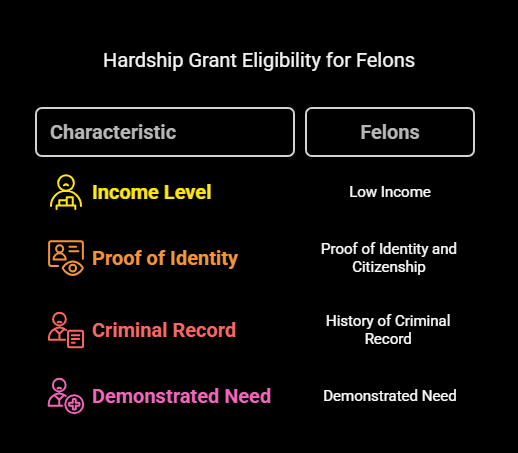
Common Eligibility Requirements:
- Low Income: Proof of income below a specific threshold.
- Proof of Identity and Citizenship: Often required for government programs.
- History of Criminal Record: Some grants are exclusively for felons.
- Demonstrated Need: A statement or form describing financial hardship.
Start With 211 for Local Emergency Assistance
For someone who needs help immediately, 211 can be one of the most practical starting points.
United Way’s 211 network connects people with local resources involving needs such as:
- Housing
- Rent assistance
- Utility bills
- Food
- Transportation
- Healthcare
- Mental health services
- Employment
- Childcare
- Legal assistance
- Emergency shelter
The exact services available depend on location and funding.
When contacting 211, don’t simply say, “I need a grant.” Give the specialist a concrete description of the problem.
For example:
“I recently returned from incarceration. I have no income, need temporary housing, and need transportation to job interviews. What local programs can help with those expenses?”
That description gives the referral specialist several practical categories to search.
Why 211 can be useful after incarceration?
A national web search might return programs that aren’t available in your county. A local referral network can identify community resources closer to where you actually live.
The caller may be referred to:
- A homeless-services provider
- A food pantry
- A community action agency
- A rental assistance program
- A transportation program
- A workforce center
- A nonprofit serving returning citizens
The assistance may not arrive as cash. It can still reduce expenses.
What Types of Hardship Grants Are Available for Felons?
Felons have access to several grant types, including federal, state, local, and private grants. Below are some of the primary categories:
1. Federal Hardship Grants for Basic Needs
Federal government grants offer essential support, particularly through housing, food, and health services.
- Supplemental Nutrition Assistance Program (SNAP): SNAP provides monthly funds to cover grocery expenses for low-income individuals, including felons.
- Temporary Assistance for Needy Families (TANF): TANF offers cash assistance to help with basic needs. Eligibility varies by state, but felons with children are often eligible.
- Medicaid: This program provides health coverage to low-income individuals and families. Felons typically qualify based on income and family size.
2. Housing Assistance Grants
Finding stable housing can be one of the biggest challenges for felons. Grants and housing programs help make it easier to find felon friendly apartments.
- Housing Choice Voucher Program (Section 8): This program provides rental assistance for low-income individuals, including felons, by subsidizing a portion of the rent in approved housing units.
- Emergency Solutions Grant (ESG): ESG offers funding to non-profit organizations that help homeless individuals, including those recently released from prison, by covering emergency shelter costs, transitional housing, and counseling.
- Continuum of Care (CoC) Program: CoC is another HUD program supporting long-term housing solutions for homeless individuals, including felons.
3. Education and Workforce Development Grants
Education and job training grants help felons acquire new skills, increasing their chances of employment.
- Federal Pell Grants: Pell Grants fund low-income students pursuing higher education. Felons can apply if they meet the income requirements and are enrolled in an eligible program.
- Second Chance Pell Experiment: This initiative, part of the Pell Grant program, specifically funds incarcerated individuals pursuing education. Certain colleges participate in this program and provide guidance on reentry.
- Workforce Innovation and Opportunity Act (WIOA): WIOA funds job training and workforce development programs that assist felons with skill-building and employment preparation.
4. Private and Nonprofit Organization Grants
Numerous nonprofit organizations and foundations provide hardship grants and support to felons.
- The Salvation Army: This organization offers emergency financial assistance, including housing, food, and clothing, through local branches.
- The Doe Fund: Provides job training, housing, and support services to help formerly incarcerated individuals reintegrate into the workforce.
- Amity Foundation: This organization offers housing, employment assistance, and substance abuse counseling to individuals with criminal backgrounds.
5. Reentry and Reintegration Grants
Some programs specifically support felons in their reintegration journey, providing structured assistance for reentry into society.
- Second Chance Act Grant: The Department of Justice’s Second Chance Act Grant program funds organizations that help felons reintegrate, offering resources for housing, job training, and life skills.
- Prison Entrepreneurship Program (PEP): PEP offers a specialized curriculum that teaches business and entrepreneurial skills to felons to help them create employment opportunities upon release.
Prepare Your Documents Before Applying
Having the right documents can speed up applications. Create a folder—physical or digital—with copies of:
- Government-issued identification
- Social Security card or number
- Birth certificate
- Release documents
- Proof of address
- Parole or probation information
- Income records
- Pay stubs
- Benefit statements
- Bank information when legitimately required
- Lease or housing documentation
- Utility bills
- Medical records when relevant
- School enrollment information
- FAFSA information
- Training-program documentation
Keep the originals in a secure location.
What if you don’t have identification?
Ask your reentry case manager, corrections agency, local nonprofit, or state identification agency about replacement documents.
Identification can unlock other services.
Without an ID, applying for housing, employment, banking services, education, and benefits can become much harder.
Build a One-Page Financial Hardship Statement
A short, factual hardship statement can help when applying to nonprofits and emergency-assistance programs.
Include:
- Your current living situation
- Your income
- Your essential monthly expenses
- Your immediate need
- The amount requested
- How the money will be used
- Your employment or training plan
For example:
“I was released from incarceration on June 5, 2026. I currently have $175 in available funds and no employment income. I have secured an interview for a warehouse position on June 14. I am requesting $120 in transportation and work-clothing assistance so I can attend interviews and begin employment.”
Specific numbers make the request easier to understand.
Compare that with:
“I desperately need financial help.”
The second statement communicates urgency but gives the organization little information to evaluate.
How to Apply for Hardship Assistance Step by Step?
A structured approach can save time.
Step 1: Identify the immediate crisis
Choose the most urgent problem:
- Food
- Shelter
- Rent
- Utilities
- Transportation
- Medical care
- Identification
- Employment
- Education
Don’t try to solve every problem simultaneously.
Start with survival needs.
Step 2: Call 211
Explain the situation and ask for local resources.
Step 3: Contact your workforce center
Ask about WIOA-funded training and supportive services.
Step 4: Check state benefits
Review SNAP, Medicaid, cash assistance where applicable, and other state programs.
Step 5: Contact your housing authority
Ask about current waiting lists and local housing resources.
Step 6: Contact reentry organizations
Look for nonprofit providers serving returning citizens.
Step 7: Prepare documentation
Keep copies of your identification, income records, release information, and bills.
Step 8: Submit applications
Track each application.
Record:
- Organization
- Contact person
- Application date
- Program
- Documents submitted
- Follow-up date
- Result
Step 9: Follow up
Call politely after the stated processing period.
Step 10: Ask for referrals after a denial
A denial doesn’t have to be the end. Ask:
“Do you know another organization that serves people with this need?”
A referral can lead to the right program.
How Effective Are Hardship Grants for Felons?
Hardship grants have proven effective in helping felons achieve stability, but success depends on individual commitment and the level of available support. For example, studies show that individuals who participate in programs like PEP have a lower rate of recidivism and higher employment rates, significantly improving their quality of life post-incarceration.

Statistics Highlighting Grant Effectiveness:
- Pew Charitable Trusts: Reports a 35% lower recidivism rate among felons who participate in structured reentry programs.
- Federal Pell Grant Program: Shows a 13% increase in job placement rates among felons who complete educational programs while incarcerated.
Conclusion
Hardship grants for felons are a valuable lifeline for individuals seeking stability and a chance to reintegrate successfully. From housing and food to education and job training, these programs provide comprehensive support to help felons overcome barriers and start anew. For those committed to change, hardship grants offer essential resources that make the road to recovery and reintegration achievable.
FAQs
Can Felons Receive Financial Aid for Education?
Yes, felons can qualify for Pell Grants and other educational assistance, especially through programs like the Second Chance Pell Experiment, which helps incarcerated individuals access college-level courses.
What Housing Assistance Options Are Available for Felons?
Felons can access rental assistance through programs like Section 8 and ESG, as well as supportive housing provided by organizations such as the Salvation Army and CoC.
Are Hardship Grants Available for Medical Expenses?
Yes, programs like Medicaid offer coverage for low-income individuals, including felons, to assist with healthcare costs.
How Long Does It Take to Receive Assistance?
The time varies by program. Some applications, such as those for Medicaid and SNAP, are processed quickly, while others, like housing assistance, may take weeks to months.