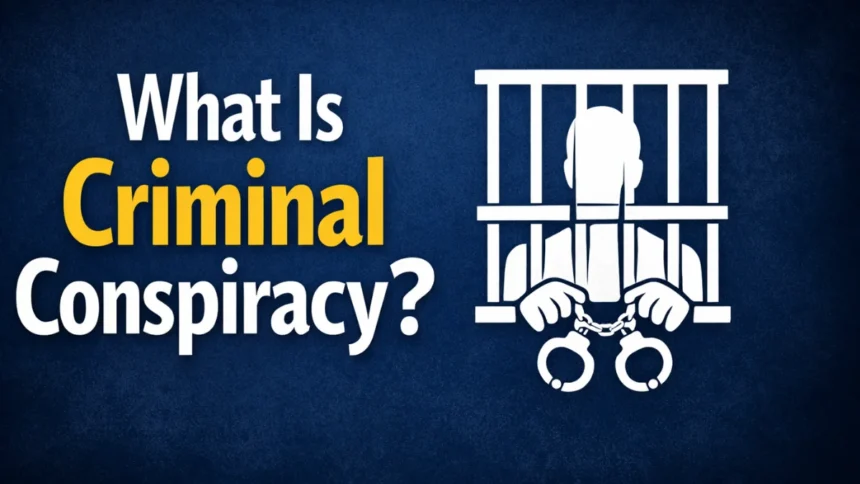
Criminal conspiracy is one of the most misunderstood yet frequently charged offenses in modern criminal law. A simple agreement between two people can sometimes lead to serious felony charges, even when no crime actually occurs. According to the U.S. Department of Justice (DOJ), conspiracy charges are among the most commonly used tools in federal prosecutions because they allow law enforcement to intervene before a planned crime is completed.
Criminal conspiracy is a crime that occurs when two or more people agree to commit an illegal act, and at least one person takes a step toward completing that act. The law treats conspiracy as dangerous because group planning increases the likelihood of real harm. Federal courts consistently emphasize that criminal agreements magnify risk, coordination, and damage.
A person can face conspiracy charges even when:
- The crime fails
- The crime never starts
- The person plays a minor role
- The person never personally commits the illegal act
That’s the part most defendants never expect.
Legal Defination of Criminal Conspiracy
Under 18 U.S. Code § 371, criminal conspiracy is defined as:
“If two or more persons conspire either to commit any offense against the United States, or to defraud the United States, and one or more of such persons do any act to effect the object of the conspiracy…”
This statute governs federal conspiracy charges and applies nationwide across all 50 states.
The 4 Core Elements of Criminal Conspiracy
To prove criminal conspiracy in federal court, prosecutors must establish four specific elements beyond a reasonable doubt.
1. Agreement Between Two or More People
An agreement can be:
- Written, such as emails or contracts
- Spoken, such as phone calls or meetings
- Implied, shown through coordinated actions
No formal contract is required. A handshake, text message, or coded language can qualify.
2. Intent to Commit an Illegal Act
All parties must knowingly intend to achieve an unlawful objective.
Accidental cooperation does not qualify. Mere association does not qualify. Shared criminal intent does.
3. Knowledge of the Conspiracy
Each defendant must understand:
- The general purpose of the plan
- That the plan involves illegal conduct
Full knowledge of every detail is not required.
4. Overt Act in Furtherance of the Conspiracy
At least one overt act must occur. This act does not have to be illegal.
Examples includes are renting a car, purchasing equipment, making phone calls and transferring money. That single action completes the crime of conspiracy.
Criminal Conspiracy vs Attempt
Criminal conspiracy and criminal attempt are separate offenses under U.S. law.
| Factor | Criminal Conspiracy | Criminal Attempt |
|---|---|---|
| Number of people | Minimum 2 | Can be 1 |
| Focus | Agreement | Action |
| Crime completion | Not required | Not required |
| Punishment | Often equal to main crime | Usually less severe |
Conspiracy focuses on group planning, while attempt focuses on individual effort.
Types of Criminal Conspiracy Charges in the United States
Federal and state prosecutors use conspiracy charges in several major categories.
1. Drug Conspiracy Charges
Drug conspiracy charges account for over 40% of federal conspiracy prosecutions, according to U.S. Sentencing Commission data.
Examples include:
- Conspiracy to distribute cocaine
- Conspiracy to manufacture methamphetamine
- Conspiracy to traffic fentanyl
Penalties often match the underlying drug offense, ranging from 5 years to life imprisonment.
2. White-Collar Criminal Conspiracy
White-collar conspiracies involve financial or corporate misconduct.
Common charges include:
- Conspiracy to commit wire fraud
- Conspiracy to commit bank fraud
- Conspiracy to commit securities fraud
Penalties:
- Up to 5 years in federal prison under §371
- Higher penalties when tied to fraud statutes
- Fines up to $250,000 per individual
3. Conspiracy to Defraud the United States
This charge applies when defendants interfere with lawful government functions.
Examples:
- Tax evasion schemes
- Medicare fraud networks
- Immigration document fraud
This offense does not require financial loss—interference alone is enough.
4. Violent Crime Conspiracy
Violent conspiracies carry the harshest penalties.
Examples include:
- Conspiracy to commit murder
- Conspiracy to commit kidnapping
- Conspiracy to commit terrorism
Sentences often equal the punishment for the planned violent crime.
Learn More: Definition of Larceny, Theft & When Larceny Becomes a Felony?
Criminal Conspiracy Charges at the State Level
All 50 states recognize criminal conspiracy, though definitions vary.
For example:
- California Penal Code §182 defines conspiracy broadly
- New York Penal Law §105 divides conspiracy into six degrees
- Texas Penal Code §15.02 requires an overt act
Despite variations, the core concept remains the same: agreement plus intent plus action.
How Criminal Conspiracy Is Proven in Court?
Prosecutors rely heavily on evidence showing coordination.
Common evidence includes:
- Text messages and emails
- Recorded phone calls
- Surveillance footage
- Bank transactions
- Testimony from co-conspirators
Federal cases often involve cooperating witnesses, who receive reduced sentences in exchange for testimony.
Criminal Conspiracy Punishments and Sentencing
Under 18 U.S.C. § 371, federal conspiracy carries:
- Maximum 5 years in prison
- Maximum $250,000 fine
- Or both
However, sentencing increases when:
- The underlying crime carries higher penalties
- Mandatory minimums apply
- Firearms or violence are involved
Judges use the Federal Sentencing Guidelines to calculate final penalties.
Can You Be Charged Without Committing the Crime?
Yes. A defendant can be convicted of criminal conspiracy even when:
- The planned crime never happens
- Law enforcement intervenes early
- The plan collapses
The agreement itself is the crime.
Common Defenses to Criminal Conspiracy Charges
Defense strategies depend on facts, but common defenses include:
1. No Agreement Existed
Parallel actions do not prove conspiracy.
2. Lack of Intent
Mere presence or knowledge does not equal intent.
3. Withdrawal from the Conspiracy
Withdrawal must occur before any overt act.
4. Entrapment
Government agents cannot induce criminal agreements unlawfully.
Each defense requires precise evidence and legal strategy.
Final Thought
Criminal conspiracy law allows U.S. prosecutors to stop crimes before they happen, but it also carries serious risks for defendants. A conversation, a plan, or a single step can trigger felony charges with life-altering consequences.
Understanding how conspiracy works under U.S. law empowers citizens, students, and defendants to recognize legal boundaries before crossing them. Planning matters. Agreement matters. And under American criminal law, intent shared is intent punished.
FAQs
Is criminal conspiracy a felony in the U.S.?
Yes, criminal conspiracy is usually charged as a felony under federal law.
Can conspiracy charges be dropped?
Charges can be dismissed if prosecutors fail to prove agreement, intent, or overt acts.
Can one person be convicted alone?
Yes, when co-conspirators are unindicted or deceased.
Does conspiracy require success?
No. Failure does not negate conspiracy liability.