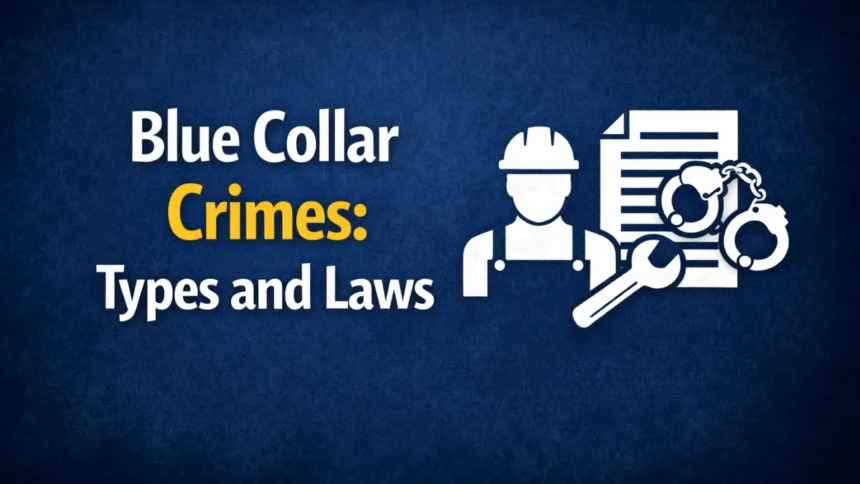
Blue-collar crime in the United States refers to non-violent, financially or physically damaging offenses typically committed by individuals working in manual labor, trade, or service-based occupations. These crimes impact employers, consumers, unions, and local communities through measurable financial loss, safety risks, and declining trust.
According to the Federal Bureau of Investigation (FBI), property crimes—including theft, vandalism, and motor vehicle theft—accounted for over 14 million reported incidents in the United States in 2024, causing an estimated $463 billion in total losses.
Many of these offenses fall under the umbrella of blue-collar crime, a category that receives far less media attention than white-collar crime but causes daily harm to American businesses and workers. From stolen construction equipment in Texas to payroll fraud in Ohio factories, blue-collar crime affects nearly every U.S. industry.
What Is Blue-Collar Crime?
Blue-collar crime refers to non-violent criminal acts committed primarily for immediate financial gain or material benefit by individuals in manual labor, skilled trade, or service occupations.
These crimes usually involve:
- Physical access to property
- Hands-on manipulation of goods or tools
- Direct interaction with workplaces or job sites
Core Characteristics of Blue-Collar Crime
There are 6 defining characteristics that distinguish blue-collar crime in the U.S.:
- Direct physical action, such as stealing tools or materials
- Immediate financial benefit, measured in cash or goods
- Lower levels of planning compared to corporate fraud
- Occurrence at job sites, warehouses, or retail locations
- Higher detection through eyewitnesses or surveillance
- Prosecution under state criminal law rather than federal regulatory law
Blue-Collar Crime vs White-Collar Crime
The difference between blue-collar crime and white-collar crime becomes clearer through direct comparison.
| Category | Blue-Collar Crime | White-Collar Crime |
|---|---|---|
| Typical offender | Laborers, technicians, service workers | Executives, managers, professionals |
| Crime location | Job sites, stores, factories | Offices, financial institutions |
| Method | Physical theft or deception | Paper trails, digital manipulation |
| Financial scale | $500 to $50,000 per incident | $100,000 to billions |
| Examples | Tool theft, vandalism, payroll fraud | Insider trading, embezzlement |
Blue-collar crime causes frequent, smaller losses, while white-collar crime causes less frequent but massive losses.
Common Types of Blue-Collar Crime in the United States
There are 10 major types of blue-collar crime commonly reported across U.S. states.
1. Theft
Theft remains the most reported blue-collar offense. Examples include stolen copper wiring, missing construction tools, and shoplifting inventory. Retail theft alone caused $112.1 billion in losses in 2022, according to the National Retail Federation.
2. Vandalism
Vandalism involves intentional property damage, such as graffiti, broken equipment, or damaged vehicles. The FBI reported over 1.1 million vandalism incidents in 2022, with average repair costs exceeding $1,200 per incident.
3. Workplace Fraud
Workplace fraud includes falsified timecards, fake injury claims, and misuse of company resources. A typical example involves an employee reporting 10 hours of overtime while working only 6 hours.
4. Payroll and Time Theft
Time theft costs U.S. employers an estimated 7% of gross payroll annually, according to the American Payroll Association. Examples include buddy punching and falsified attendance logs.
5. Embezzlement (Low-Level)
Small-scale embezzlement involves cash skimming, register manipulation, or diverting company supplies. Amounts range between $1,000 and $25,000 per case in most state prosecutions.
6. Receiving Stolen Property
Workers sometimes purchase or resell stolen goods, such as electronics or vehicle parts. This offense frequently appears in logistics and warehouse operations.
7. Insurance Fraud
Insurance fraud includes staged workplace injuries or false disability claims. The Coalition Against Insurance Fraud estimates $80 billion in annual losses nationwide.
8. Bribery and Kickbacks
Bribery occurs when workers accept money or goods to overlook safety violations or theft. A construction inspector accepting $500 to ignore code violations fits this category.
9. Drug-Related Workplace Crimes
Drug distribution at job sites creates safety risks and legal exposure. The U.S. Department of Labor reports higher injury rates at workplaces with substance abuse issues.
10. Labor Union-Related Offenses
These crimes include misuse of union funds and coercion during labor disputes.
Key Causes of Blue-Collar Crime in the U.S.
There are 7 measurable causes behind blue-collar crime.
1. Financial Pressure
Workers earning under $40,000 annually face higher temptation to commit petty theft, according to BJS income data.
2. Weak Internal Controls
Job sites without inventory tracking experience 3 times more theft incidents.
3. Poor Supervision
A lack of on-site management increases crime rates by 22%, based on OSHA safety audits.
4. Substance Abuse
Employees with substance dependency show 2.5x higher disciplinary violations.
5. Workplace Culture
Tolerating small theft encourages larger crimes over time.
6. Low Risk of Detection
Crimes increase when surveillance and audits remain absent.
7. Job Insecurity
Temporary workers commit property offenses at higher rates than permanent staff.
Legal Consequences and Penalties in the United States
Blue-collar crime penalties vary by state, but 5 common legal outcomes apply nationwide.
Misdemeanor Charges
Theft under $1,000 typically leads to:
- Up to 12 months in jail
- Fines between $500 and $2,500
- Probation and restitution
Felony Charges
Theft exceeding $2,500 to $5,000, depending on state law, can result in:
- 1 to 10 years in prison
- Permanent criminal record
- Loss of professional licenses
Civil Liability
Employers may sue offenders for damages and recovery costs.
Employment Consequences
Convictions lead to termination and future hiring barriers.
Federal Charges
Crimes involving interstate commerce trigger federal prosecution.
Economic and Social Impact
Blue-collar crime produces 5 measurable impacts on American society.
- Increased consumer prices due to loss recovery
- Reduced business profits and job cuts
- Higher insurance premiums
- Lower workplace morale
- Community safety decline
Small businesses suffer most, with losses averaging $15,000 per incident.
Prevention Strategies That Work in the U.S.
There are 8 proven prevention strategies.
- Install surveillance cameras at entry points
- Conduct regular inventory audits
- Use biometric time clocks
- Enforce zero-tolerance theft policies
- Offer employee assistance programs
- Improve wages and job stability
- Rotate job duties
- Encourage anonymous reporting systems
According to the U.S. Chamber of Commerce, businesses using layered security reduce theft by up to 40%.
Blue-Collar Crime Examples
- A Florida warehouse worker stole $18,000 in electronics over 6 months
- A California construction crew lost $75,000 in tools due to unsecured sites
- An Ohio factory uncovered 1,200 falsified time entries in one year
Final Thoughts
Blue-collar crime in the United States may seem small on an individual level, yet the combined damage reaches hundreds of billions of dollars each year. Theft, fraud, and workplace misconduct hurt honest workers, strain employers, and weaken communities.
Clear policies, fair wages, strong supervision, and modern security tools reduce these crimes measurably. Awareness remains the first step. Action delivers results. When workplaces invest in trust, accountability, and prevention, blue-collar crime loses its foothold—and everyone benefits.
FAQs
What is the main difference between blue-collar crime and violent crime?
Blue-collar crime involves property or financial harm without physical violence.
Is blue-collar crime prosecuted less harshly?
Sentences remain shorter, but convictions still carry long-term consequences.
Which industries face the highest risk?
Retail, construction, manufacturing, and logistics report the highest incidents.
Does technology reduce blue-collar crime?
Yes. Access controls and monitoring reduce incidents significantly.