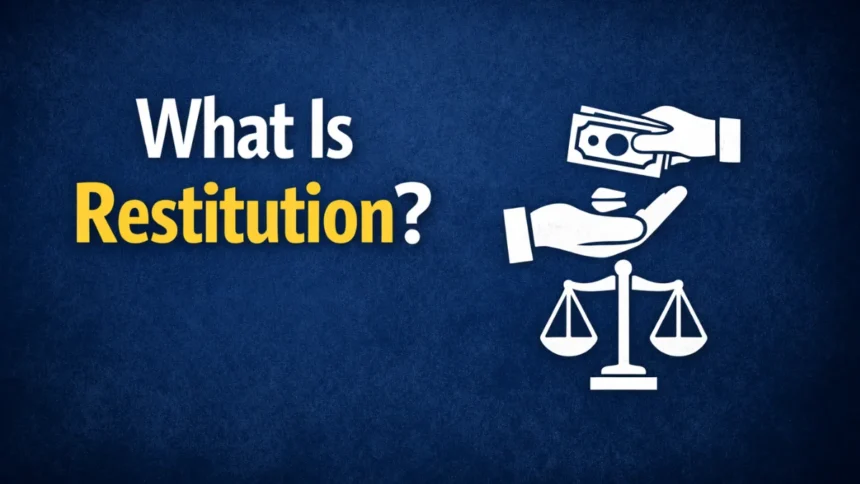
Restitution is a court-ordered payment that requires a person who caused harm to repay the victim for measurable financial losses. In the United States, restitution plays a central role in criminal justice and civil law by focusing on repairing damage rather than punishment alone.
- What Is Restitution?
- The Legal Definition of Restitution
- Restitution in Criminal Law
- Restitution in State Criminal Courts
- Restitution in Civil Law
- Who Pays Restitution?
- Who Receives Restitution?
- How Courts Calculate Restitution Amounts?
- Restitution vs. Fines vs. Compensation
- What Happens If Restitution Is Not Paid?
- Restitution and Probation or Parole
- Restitution in Juvenile Cases
- Why Restitution Matters in the U.S. Justice System?
- Final Thoughts
- FAQs
What Is Restitution?
According to the United States Department of Justice (DOJ), restitution is a legal mechanism that requires offenders to compensate victims for the financial losses directly caused by criminal conduct. The DOJ emphasizes that restitution exists to make victims whole, not to penalize defendants beyond their responsibility.
Restitution means repayment for harm, measured in exact dollar amounts tied to real losses. Courts calculate restitution using documents such as medical bills, repair invoices, wage records, and property valuations. The purpose centers on restoration, not profit, punishment, or moral judgment.
The Legal Definition of Restitution
Restitution is a court-ordered obligation requiring an offender or defendant to reimburse a victim for direct and quantifiable losses caused by a crime or wrongful act.
U.S. courts recognize restitution under two major legal areas:
- Criminal law
- Civil law
Both systems rely on evidence-based calculations rather than estimates or emotional harm.
Restitution in Criminal Law
Criminal restitution applies when a person commits a crime that results in financial loss to another person, business, or government entity.
Federal Law and Restitution
At the federal level, restitution is governed primarily by the Mandatory Victims Restitution Act (MVRA) of 1996.
Under the MVRA, federal judges must order restitution for specific crimes, including:
- Violent crimes
- Property crimes
- Fraud offenses
- Identity theft
- Financial crimes involving deception
Judges calculate restitution using exact loss figures rather than the defendant’s financial ability.
Examples of Criminal Restitution
Here are concrete examples using numeric values:
- A burglary causes $4,800 in stolen electronics and $1,200 in property damage. Total restitution equals $6,000.
- A fraud case results in $75,000 in stolen retirement funds. The restitution amount equals $75,000.
- An assault leads to $18,400 in medical bills and $3,600 in lost wages. Restitution totals $22,000.
Courts require documented proof, such as receipts, hospital invoices, and payroll records.
Restitution in State Criminal Courts
Every U.S. state allows restitution in criminal sentencing. State laws differ in procedure but follow the same core principle.
For example:
- California Penal Code §1202.4 requires full restitution for economic losses
Texas Code of Criminal Procedure Article 42.037 authorizes restitution orders
New York Penal Law §60.27 mandates restitution in applicable cases
State courts often include restitution as a condition of probation or parole.
Restitution in Civil Law
Civil restitution arises when one party unfairly benefits at another’s expense. Courts use restitution to reverse unjust enrichment.
Civil restitution applies in cases involving:
- Contract disputes
- Consumer fraud
- Unlawful business practices
- Improper property transfers
The goal remains consistent: restore the injured party to their original financial position.
Civil Restitution Example
A contractor receives $12,000 for a renovation project and completes only 30% of the work. The court orders restitution of $8,400, representing the unearned portion.
The calculation uses documented payments, material costs, and labor value.
Learn More: What Are Crimes Against Humanity?
Who Pays Restitution?
Restitution payments come from:
- Criminal defendants
- Civil defendants
- Juvenile offenders, sometimes shared with parents or guardians
Courts assign responsibility based on direct causation. Shared responsibility applies when multiple offenders contribute to a single loss.
Who Receives Restitution?
Restitution recipients include:
- Individual victims
- Businesses
- Insurance companies, after victim reimbursement
- Government agencies
Priority goes to direct victims before third parties.
How Courts Calculate Restitution Amounts?
Courts rely on precise documentation rather than estimates. Accepted loss categories include:
- Medical expenses
- Therapy costs
- Property repair or replacement
- Lost wages
- Funeral expenses
- Stolen funds
Excluded losses include emotional distress, pain, and suffering, or speculative future earnings.
Example
A hit-and-run accident causes:
- Emergency care: $9,200
- Physical therapy: $4,800
- Missed work wages: $6,000
Total restitution equals $20,000.
Restitution vs. Fines vs. Compensation
These legal terms differ in purpose and destination.
Restitution
- Paid to victims
- Based on actual loss
- Focused on restoration
Fines
- Paid to the government
- Used as punishment
- Fixed by statute
Compensation
- Paid through victim compensation funds
- Funded by taxpayers or fees
- Used when restitution is unavailable
Restitution prioritizes victims directly harmed by misconduct.
What Happens If Restitution Is Not Paid?
Courts enforce restitution orders using legal mechanisms such as:
- Wage garnishment
- Tax refund interception
- Bank account levies
- Probation violation hearings
Failure to pay restitution can result in extended probation or additional penalties, although courts consider genuine inability to pay.
Restitution and Probation or Parole
Restitution often becomes a mandatory condition of probation or parole. A defendant must:
- Make regular payments
- Follow court-approved payment schedules
- Provide financial disclosures if required
Violation triggers judicial review.
Restitution in Juvenile Cases
Juvenile courts emphasize accountability and rehabilitation. Restitution in juvenile cases commonly includes:
- Property damage repair
- Theft reimbursement
- Community service equivalents
Courts may involve parents for shared responsibility.
Why Restitution Matters in the U.S. Justice System?
Restitution strengthens trust in the legal system by prioritizing victims. Studies by the Bureau of Justice Statistics indicate that financial loss remains the most reported harm in non-violent crimes. Restitution addresses that loss directly.
Final Thoughts
Restitution stands as one of the most practical remedies in American law. Courts use restitution to repair measurable harm, ensure accountability, and place victims at the center of justice. Unlike fines or damages, restitution focuses on real losses, real numbers, and real recovery.
Understanding restitution empowers victims to seek repayment and helps defendants recognize their legal responsibilities. Whether applied in federal court, state court, or civil litigation, restitution remains a cornerstone of fairness in the U.S. legal system.
FAQs
Is restitution mandatory in all criminal cases?
Restitution is mandatory for specific federal crimes under the MVRA and discretionary in other cases.
Can restitution be reduced?
Courts adjust restitution only when documentation proves a lower actual loss.
Does insurance affect restitution?
Insurance payments may reduce restitution owed to victims but can shift repayment to insurers.
Can restitution be discharged in bankruptcy?
Criminal restitution cannot be discharged in bankruptcy under federal law.
How long does restitution last?
Restitution orders often remain enforceable for 20 years or more, depending on jurisdiction.